
Halloween in the Hollow brings spooky traditions to the Square
Why do we carve pumpkins, hand out candy, and fear a headless horseman? Discover the why behind the holiday habits.
1:30 a.m. Oct. 30, 2026

DUANE CROSS
MCO Publisher•Editor
There will be grinning jack-o'-lanterns, costumed kiddos hauling buckets of Halloween candy, and a mysterious horseman who somehow manages to ride without his head. Halloween in the Hollow returns to Lynchburg Square on Saturday, Oct. 31, with a pumpkin-carving contest, trunk-or-treating, costume contests, and a dance party featuring DJ Dusty Dickey.
The festivities begin at noon with registration for the Pumpkin Carving Contest at the gazebo, followed by judging at 2 p.m. Lynchburg Elementary School will host Trunk-or-Treat from 4-5:30 p.m., while trick-or-treating around the Square begins at 5 p.m. Costume contests follow at 5:15, with the Headless Horseman scheduled to make his first appearance at 6:40. Dickey fires up the dance party at 6:45, and the mysterious rider returns for one final trip around the Square at 7:30.
For those who would rather sing than dance, the Bar-B-Que Caboose Cafe at 217 Main St. will host Skaraoke from 6-8 p.m. Participants are encouraged to wear their best Halloween costumes, belt out their favorite karaoke tunes, and compete for a cash prize awarded to the costume contest winner.
For Moore County families, it's an evening of homemade costumes, sticky fingers, and photographs that will probably embarrass somebody when they're old enough to date.
But have you ever wondered why we carve faces into pumpkins, hand out candy to strangers, or get such a kick out of a fellow riding around without his head?
The answers reach back centuries, across the Atlantic, and into one of America's most famous ghost stories. And some of that history is considerably stranger than anything you'll see wandering around the Square.
A fellow named Jack and a very unfortunate turnip
Long before somebody figured out how to turn a pumpkin into a grinning orange masterpiece, folks in Ireland were carving faces into turnips.
Yes, turnips.
The tradition reaches back to Irish folklore and a particularly troublesome character known as Stingy Jack, a man who apparently had a talent for getting himself into trouble.
According to the legend, Jack managed to trick the devil more than once, eventually securing a promise that the devil wouldn't claim his soul. Unfortunately for Jack, his behavior also kept him out of heaven. When he died, Jack discovered that neither destination wanted him.
The devil reportedly sent him wandering through the darkness with nothing but a burning coal for light. Jack placed the ember inside a hollowed-out turnip, creating a makeshift lantern as he roamed the earth. The wandering spirit became known as Jack of the Lantern, a name that eventually evolved into jack-o'-lantern.
In Ireland and Scotland, families carved frightening faces into turnips and other root vegetables, placing them near doors and windows to ward off wandering spirits.
When Irish immigrants brought the tradition to America during the 19th century, they discovered something that made the whole business considerably easier: pumpkins.
Native to the Americas, pumpkins were plentiful, larger, and much easier to hollow out than a stubborn turnip. The tradition caught on, and carving jack-o'-lanterns eventually became an American Halloween staple.
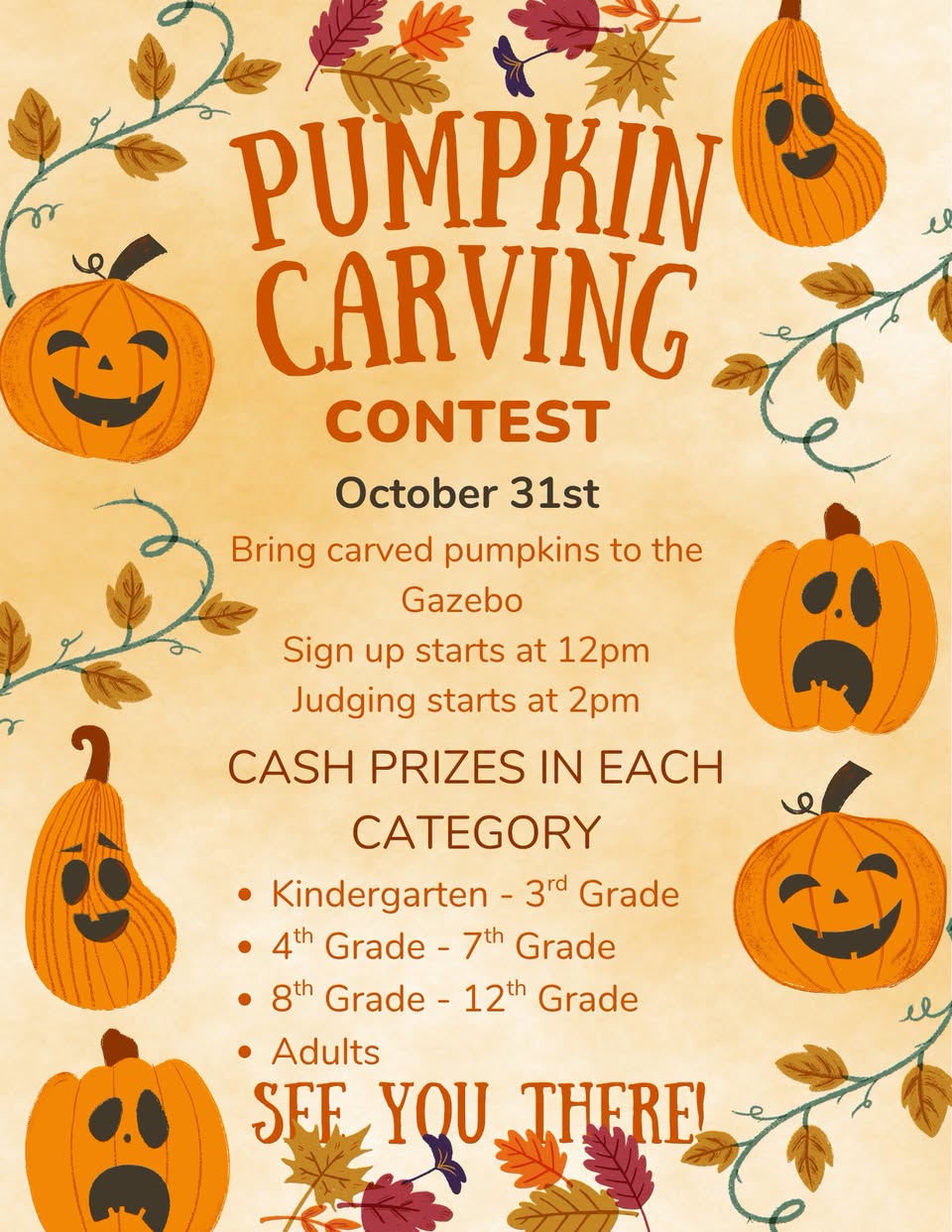
On Saturday, Moore County residents will carry on that tradition with the Pumpkin Carving Contest at the gazebo. Registration begins at noon, and contestants should arrive with their pumpkins already carved. Judging begins at 2 p.m., with cash prizes awarded in four divisions: kindergarten through third grade, fourth through seventh grade, eighth through 12th grade, and adults.
Whether the winning entries feature elaborate designs or the familiar triangle eyes and crooked smile, they'll be part of a custom that has survived generations.
And if your pumpkin ends up looking a little lopsided, consider yourself lucky. At least you didn't have to carve a turnip.
How Halloween became a candy business
The children wandering the Square with buckets, bags, and pillowcases Saturday evening might find this next bit of history particularly disturbing.
Halloween wasn't always about candy. Those miniature chocolate bars and individually wrapped sweets are relatively recent additions to a holiday with roots reaching back more than a thousand years.
Some of Halloween's customs grew out of Samhain, the ancient Celtic festival marking the end of the harvest season. People believed the boundary between the living and the dead grew thinner during this time, and disguises became part of the observance. Other traditions developed around the Christian observances of All Saints' Day and All Souls' Day.
In medieval Britain, a practice known as souling involved people visiting homes and receiving small cakes in exchange for offering prayers for the dead. In Ireland and Scotland, children participated in guising, dressing in costumes and traveling from house to house. They might sing a song, recite a poem, or tell a joke before receiving food, coins, or another small gift.
That sounds suspiciously like the entertainment planned for Skaraoke on Saturday, although the folks at the Caboose probably won't be handing out soul cakes.
As Halloween traditions crossed the Atlantic, they gradually evolved into the trick-or-treating familiar to American families today. By the early 20th century, Halloween had developed something of a reputation for mischief, with pranks sometimes escalating into vandalism. Communities responded by encouraging organized celebrations and activities for children.
Trick-or-treating gained momentum during the 1930s, although World War II and sugar rationing slowed its growth. After the war, the baby boom filled American neighborhoods with children, and candy companies saw an opportunity. By the 1950s, individually wrapped treats were being marketed specifically for Halloween.
Before that, youngsters might have received apples, homemade cookies, popcorn balls, nuts, or even a few coins. By the 1970s, commercially packaged candy had become the preferred treat in many American households.
What began as a custom of exchanging a song or a prayer for something to eat had become a night when children dressed as superheroes could collect enough chocolate to stock a small convenience store.
On Saturday, Moore County's version will be considerably more convenient than knocking on doors across several neighborhoods.
Lynchburg Elementary School's Trunk-or-Treat will bring families together from 4-5:30 p.m., with volunteers distributing candy from decorated vehicles. Organizers are welcoming volunteers and donations of individually wrapped candy to help make the event a success.
Then there's the Square, where trick-or-treating begins at 5 p.m., with costume contests following at 5:15. First-, second-, and third-place awards will be presented in divisions for pre-K, kindergarten through second grade, third and fourth grades, fifth and sixth grades, junior high, high school, adults, and groups.
And somewhere in all those candy buckets, a Reese's Peanut Butter Cup will mysteriously disappear before anybody gets home. ... Parents have been investigating that particular phenomenon for generations.
The horseman who lost his head – and never found it
Of all the characters expected on the Square Saturday, none carries quite the same history as the Headless Horseman.
His story became an American literary classic in 1820, when author Washington Irving published The Legend of Sleepy Hollow.
Set in New York's Hudson River Valley, the tale follows Ichabod Crane, a superstitious schoolteacher who finds himself competing for the affections of Katrina Van Tassel. His romantic rival is Brom Bones, a mischievous local fellow who doesn't particularly appreciate Ichabod's interest in Katrina.
The community also has a terrifying local legend.
According to the story, a Hessian soldier fighting on the British side during the Revolutionary War lost his head to a cannonball. His restless spirit supposedly rides through the countryside at night, searching for the missing piece.
One evening, after attending a gathering where ghost stories have been shared, Ichabod rides home through the darkness and encounters the Headless Horseman. The rider pursues the terrified schoolteacher through the countryside, eventually hurling what appears to be his severed head at Ichabod.
By morning, Ichabod has vanished, although his horse has returned home without its saddle. Searchers eventually discover the saddle along the road and, near the bridge, Ichabod's hat beside a shattered pumpkin.
Was the schoolteacher really chased by a ghost? Or had Brom Bones dressed up as the legendary horseman to frighten his romantic competition out of town?
Irving never provides a definitive answer, although Brom's suspicious amusement whenever the story comes up suggests he might know considerably more than he's willing to admit.
Interestingly, Irving's original story never mentions Halloween. The glowing jack-o'-lantern often depicted as the horseman's head is largely a product of later illustrations and adaptations.
Still, the image became one of Halloween's most recognizable symbols, inspiring movies, television shows, books, and generations of people who enjoy a good ghost story.
More than 200 years after Irving put the tale on paper, the Headless Horseman is still making appearances. He'll make his first ride through Lynchburg at 6:40 p.m. Saturday, with a final appearance scheduled for 7:30.
And unlike Ichabod Crane, Moore County residents should have a pretty good idea where to find him.
A little history comes home to the Hollow
By Saturday evening, the same Square where neighbors stop to swap stories and catch up on county business will belong to witches, superheroes, ghosts, and a horseman who seems to have misplaced his head.
Children get to dress up and pretend to be somebody else for an evening. Parents watch them enjoy a little harmless mischief, and neighbors have an excuse to gather and catch up.
For those planning to attend, Mechanic Street North will close at 3 p.m. for the festivities at Lynchburg Elementary School. Church Street, Wiggins Avenue, and Spriggs Avenue will be closed at their intersections with Mechanic Street. Traffic leaving the school after Trunk-or-Treat will be routed to Cemetery Street.
The Square closes to traffic at 3:30 p.m. to allow participants to set up their vehicles. Visitors are encouraged to park at Wiseman Park and enter the Square near the County Building or Barrel House BBQ. The Headless Horseman's final ride is scheduled for 7:30 p.m., with streets reopening after the festivities conclude.
By Saturday night, another generation of Moore County youngsters will have their own Halloween stories to tell. There will be favorite costumes, overflowing candy buckets, and perhaps a few accounts of a mysterious horseman riding through the Square without his head.
And if you happen to spot that rider disappearing into the darkness, there's probably no reason to be alarmed.
Unless, of course, he's carrying your pumpkin.
From the Sheriff's Dept.
Headed to Halloween in the Hollow? Downtown Lynchburg will look a little different Saturday afternoon, with road closures beginning at 3 p.m. Here's how to get in, where to park, and when the streets reopen.
• 3 p.m. – Mechanic Street North closes ahead of the 4 p.m. Trunk-or-Treat at Lynchburg Elementary School. Church Street, Wiggins Avenue, and Spriggs Avenue will be closed where they meet Mechanic Street.
When Trunk-or-Treat ends, traffic leaving the school will be directed to Cemetery Street.
• 3:30 p.m. – The Square closes so participants can set up for Halloween in the Hollow, which begins at 5 p.m.
Coming downtown for the fun? Park at Wiseman Park and walk into the Square near the County Building or Barrel House BBQ.
• 7:30 p.m. – Festivities wrap up. Mechanic Street and the Square are scheduled to reopen to traffic.
Keep an eye out for little ghosts and goblins crossing the streets. They'll have candy on their minds, not traffic.


More Features

Boo-tiful Nightmares: 10 Haunting Halloween Flicks
Looking for Halloween movies? We’ve picked five classics for adults and five family favorites for the little monsters.

When the Schoolhouse Germs Come Home
That first cough from the backseat can mean trouble. Here are practical ways to keep germs from making the rounds.

Sunday Supper: Pumpkin Seeds
Turn fresh pumpkin seeds into an easy, crispy, caramelized Halloween treat with butter, brown sugar, and cinnamon.