The Big Yellow Pause
Moore County carries 478 bus riders across 12 routes as students and motorists prepare for the first morning pickup
10:22 a.m. Aug. 6, 2026

DUANE CROSS
MCO Publisher•Editor
On Friday, the first bell is not the only familiar sound returning with a new school year.
So is the low rumble of a school bus easing along Buckeye Loop or Cobb Hollow Road, cresting a hill or slowing near a driveway before daylight has fully settled over the holler.
That yellow bus is built to protect the children inside.
The students stepping toward it have no such shield.
The most dangerous part of a child’s bus ride is often not the ride at all. The National Highway Traffic Safety Administration says children are most vulnerable while approaching the bus, boarding, getting off and walking away.
That is where the rest of us come in – bus drivers, students, parents and every motorist who meets that bus along the road.
Yellow means wait. Red means stop.
A school bus’s flashing yellow lights are not an invitation to hurry past before the stop arm comes out.
They mean the bus is preparing to stop.
Drivers should ease off the accelerator, leave more room and prepare to come to a full stop. Once the red lights begin flashing and the stop arm extends, children may be stepping into the road.
Traffic must remain stopped until the bus begins moving, the driver signals motorists to proceed or the warning signals are turned off.
The rule is easy enough to remember:
See yellow, get ready. See red, stop.
Do not creep forward or ease around the bus. A child may drop a lunchbox, turn back for a book or cross from the far side of the road, hidden until the last second.
The bus is the warning.
The children may still be out of sight.
Who has to stop?
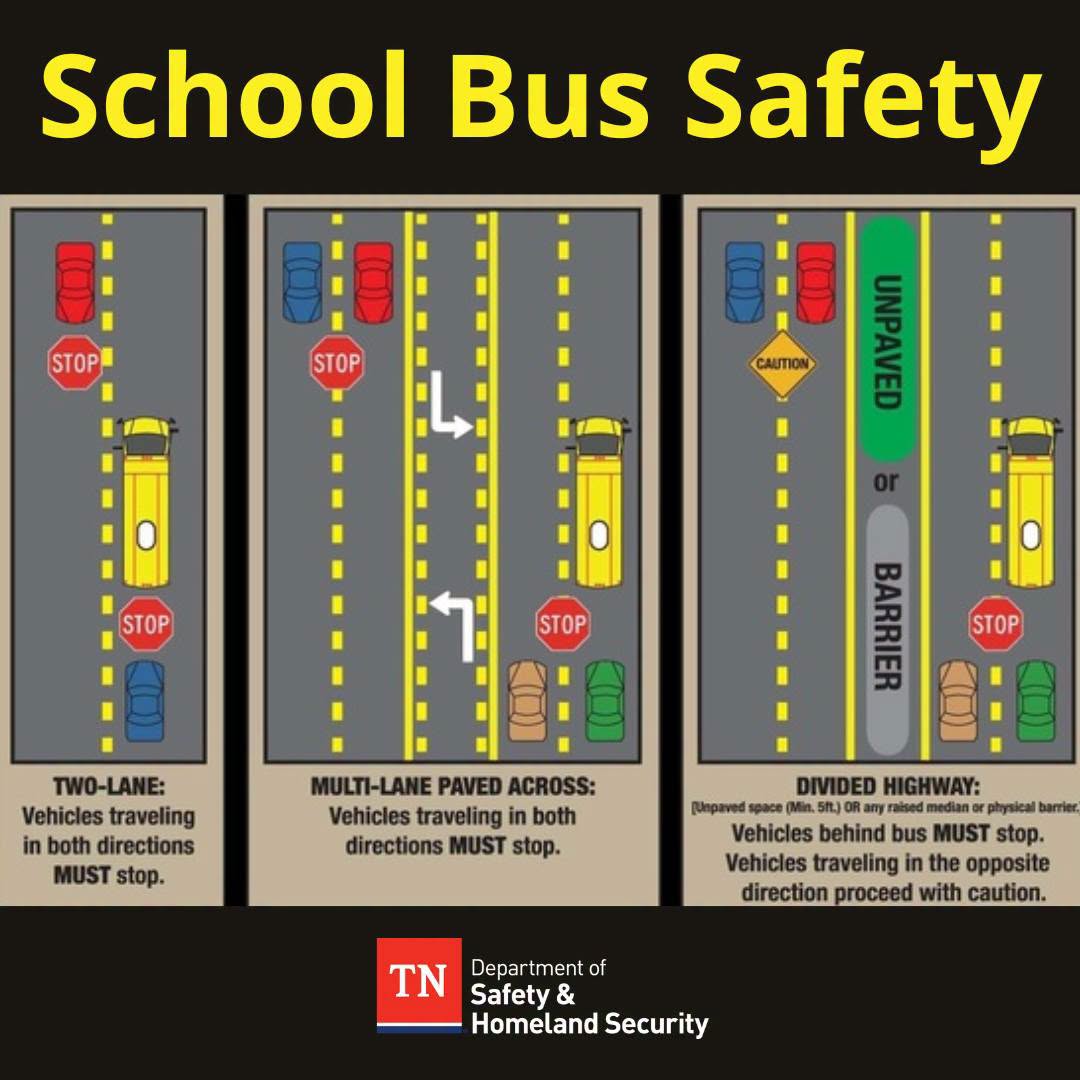
Tennessee law requires motorists approaching a stopped school bus from either direction to stop before reaching it when the bus is loading or unloading children.
On a two-lane road, traffic in both directions must stop.
The same rule applies on an undivided multilane road. A painted centerline or center turn lane does not create two separate roadways.
The exception is a highway with separate roadways divided by a median, barrier, or another intervening space unsuitable for vehicle traffic. Motorists meeting a bus stopped on the opposite roadway do not have to stop, though they should continue carefully.
When there is any doubt, stop.
A few seconds spent waiting behind a bus are easier to live with than a decision made too fast.
Passing carries more than a fine
Tennessee law makes failing to stop for a school bus a Class A misdemeanor. A first offense carries a fine of $250 to $1,000. A second or subsequent offense carries a fine of $500 to $1,000.
The consequences become far more serious when someone is struck. A driver who violates the stop law and hits another person commits a Class E felony. If that person dies, the offense rises to a Class C felony.
But a court fine is not the real measure of what is at stake.
A stop arm is extended because a child is entering the road.
Watch for the stop before the bus arrives
Drivers should begin looking for children before they see the bus.
A backpack beside a mailbox, a parent standing near the end of a driveway or two children shuffling in the morning chill may signal a stop just ahead.
That matters on roads where the next hill comes quickly, the shoulder narrows to almost nothing or summer growth crowds the view. Morning darkness, sun glare, rain and fog can make a small child nearly disappear against the roadside.
Slow down near known bus stops. Keep the phone out of your hand. Leave enough space behind the bus for its driver to see what is happening around it.
A school bus driver is watching mirrors, traffic, the door, and several children moving in different directions.
The last thing that driver needs is a motorist crowding the rear bumper.
Five giant steps
Students have their part to do, too.
Children should arrive at the bus stop about five minutes early. That keeps them from running along the road or chasing a bus that has already begun to pull away.
While waiting, students should stand at least 10 feet — about five giant steps — from the road.
There will be time for cutting up later. The edge of a road before sunrise is no place for running, pushing or horseplay.
When the bus arrives, students should wait until it stops completely, the door opens, and the driver tells them it is safe to board. They should use the handrail, find a seat and keep backpacks, instruments and other belongings out of the aisle.
Once the bus is moving, students should remain seated, keep the noise down and follow the driver’s instructions. The driver needs to hear what is happening inside and outside the bus.
After stepping off, students should move away instead of lingering beside the bus, and never cross behind the bus.
And if a phone, book, ball or lunchbox falls beneath or near it, leave it there and tell the driver. A driver may not be able to see a child bending near the wheels.
12 routes – and a push for one more
Moore County Schools currently operates 12 bus routes – 11 regular routes and one serving students with special needs. Josh Deal, the school system’s new supervisor of support services, said 478 students are registered to ride a bus in some capacity.
Deal, a former Moore County High School principal, moved into the role following Wendy Hart’s retirement.
He said the district hopes to add another route, but staffing remains the obstacle.
“I am trying to add a route soon to alleviate some pressure in some areas, but lack of full-time drivers makes it a challenge,” Deal said.
Deal said learning the ins and outs of bus routing has taken time.
“We hope to keep decreasing ride times for riders while recruiting quality drivers for our students,” he said.
Families whose children plan to ride should register them before the first morning pickup using Moore County Schools’ bus registration form.
Families with transportation questions – and anyone interested in becoming a school bus driver – may contact Deal at josh.deal@moorecountyschools.net or 931-759-7303.
Built for the road
The familiar yellow school bus is among the most carefully designed and heavily regulated vehicles on American roads.
Its size and weight help protect passengers from crash forces. High, closely spaced seats with energy-absorbing backs form a protective system known as compartmentalization.
NHTSA calls the school bus one of the safest vehicles on the road. The agency says fewer than 1% of traffic fatalities involving children occur aboard school transportation vehicles.
More than 25 million children ride more than 480,000 school buses nationwide each school day, according to the National Association of State Directors of Pupil Transportation Services.
That makes the big yellow fleet one of the country’s largest transportation systems.
Its stops are beside mailboxes, at driveways and along country roads.
Before the bus was yellow
The earliest purpose-built school vehicles did not have engines.
Comfort was not much of a selling point, either.
In 1892, Indiana-based Wayne Works built a horse-drawn “School Car” for an Ohio school district. Children entered through the rear and sat on long wooden benches running along the sides.
School buses did not settle on their famous color until 1939.
That year, rural education professor Frank W. Cyr gathered transportation officials, manufacturers and other specialists at Teachers College, Columbia University. Over seven days, they worked through 44 standards covering everything from body length and aisle width to doors and ceiling height.
They also chose yellow.
Black lettering was easier to see against it in the dim light of early mornings and late afternoons. The shade became known as National School Bus Chrome, though Cyr reportedly thought it looked more orange than yellow.
In 1938, the United States had 86,099 school buses carrying nearly 4 million children.
Today’s fleet is more than five times larger.
The buses have changed. The roads have changed. There are more cars, more distractions, and more people in a hurry.
The bargain has not changed one bit: a bus stops, drivers wait – and children get home safely.